⚡
Fast screening workflow
Multiple tension cases solved in seconds, so a configuration can be tested before the meeting, not after it.
S-QMACS is a fast-screening and engineering decision-support tool built to turn raw mooring data into answers an engineer can defend. By solving the elastic catenary for each line and tension case, S-QMACS lets you evaluate line behaviour, subsea asset clearances and touchdown parameters in seconds — long before committing to resource-heavy detailed modelling.
From grounded length and multi-buoy uplift to multi-case tension runs and anchor-end advisory, S-QMACS gives you one technical picture instead of five disconnected spreadsheets. Every result carries its governing DNV reference and its own case state, and exports to a review-ready PDF with limitations stated. It is the screening layer that lets a project move forward on engineering logic that can be checked, defended and signed off.
Screening, not guesswork: every case states the rule applied, the margin, and the reason it passed, was conditioned or was rejected — so the answer survives a reviewer, not just the meeting.
Will the line clear the pipeline? Where is touchdown? Is the line grounded or nearly taut? Which tension case governs? What has to be flagged before anything goes to the field?
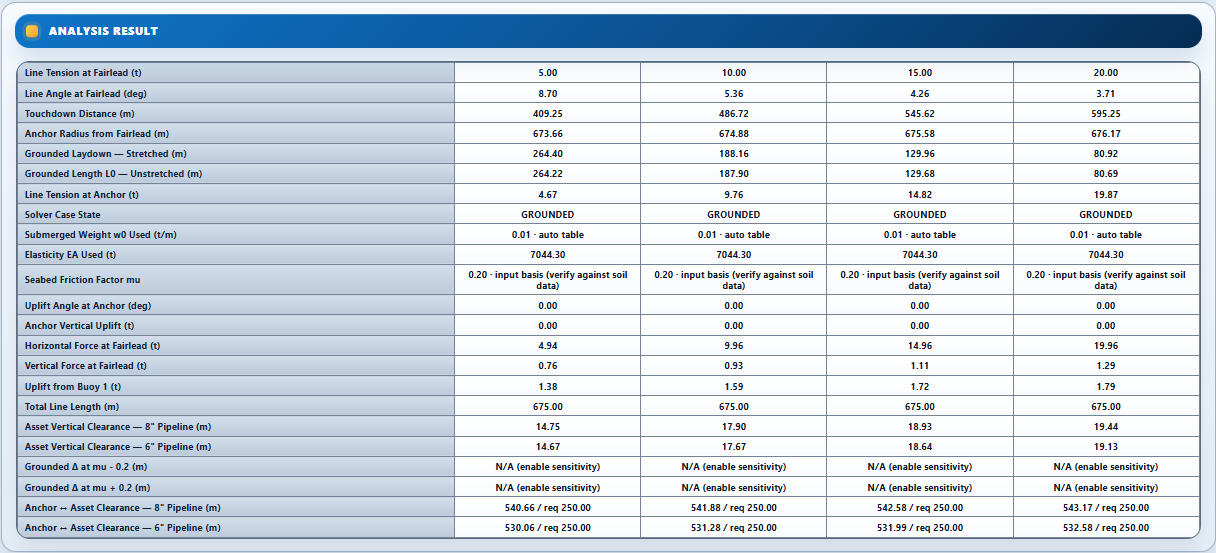
Every result is stated the way a reviewer reads it: clearance passing or failing with its margin, anchor uplift and uplift angle against their limits, and a case state of OK, conditional or invalid — with the reason spelled out. The governing tension case is identified, and anything this solver cannot resolve is flagged as such rather than smoothed over.
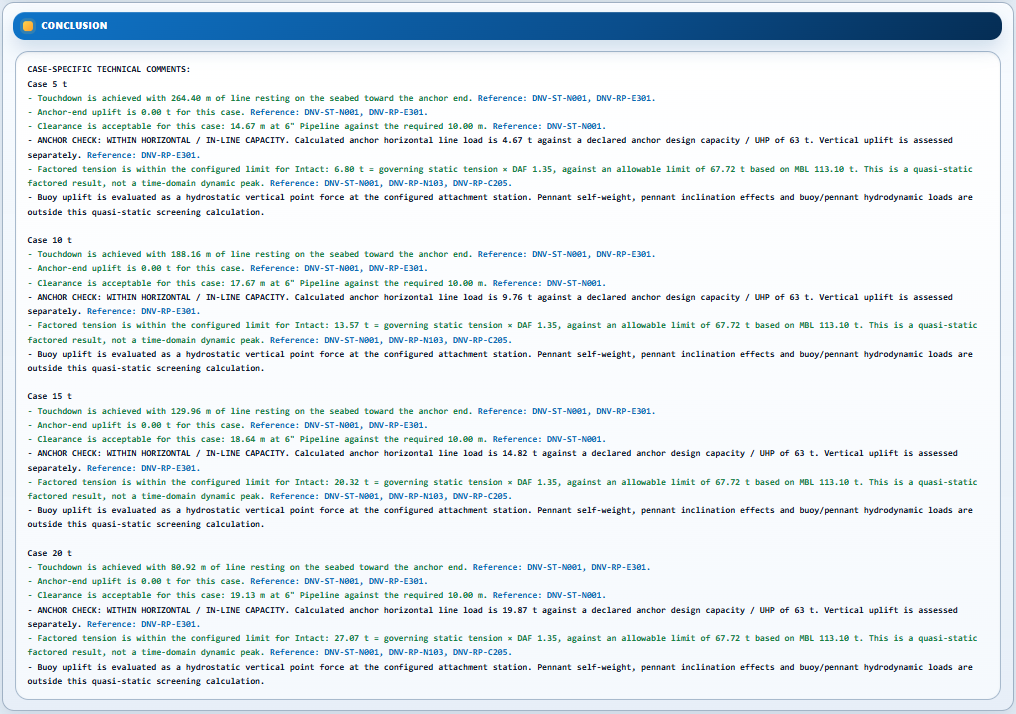
Each run produces a report-ready section: conclusion, governing case, clearance and anchor checks, buoy advisory, limitation statement and case-specific comments — the same values you see on screen, exportable as a PDF for marine warranty and client review.
Use S-QMACS for rig move and mooring checks, early engineering review, client discussions, comment closure and quick sensitivity runs — before detailed analysis is commissioned.
S-QMACS gives offshore engineers a sharp first-pass answer on catenary shape, asset clearance and anchor-end behaviour — inside the time it takes to open a spreadsheet, not a week.
Multiple tension cases solved in seconds, so a configuration can be tested before the meeting, not after it.
Anchor-to-asset distance is reported against the governing DNV rule, with the margin shown per case.
Touchdown distance and grounded laydown show whether the line stays on the seabed or is heading for taut behaviour.
Inputs and outputs follow the checks that actually decide an offshore case: line profile, clearance, touchdown and buoy response.
Buoy station, attachment depth, submergence and effective uplift — so a buoy that stops working is visible, not assumed.
Conclusion, governing case and case-specific comments export straight to a PDF for client and warranty review.
Built for offshore practitioners who need to set up line data quickly, compare tension cases, check clearance risk and walk into the room with a screening output that can be discussed — not explained.
Screen line profile, touchdown movement, grounded length and anchor-end uplift before the team commits to the next operational step.
Check anchor-to-asset distance against the governing DNV rule, plus vertical clearance at each crossing — before the pattern is fixed.
Turn assumptions, tension cases and results into one plot and one report-style PDF that carries the same numbers as the screen.
Every plan unlocks the full calculation set — anchor and asset clearance, multi-case tension runs, buoy advisory, report export. Only the access period changes. Payment is handled through secure checkout, and your activation token is sent to the email address used at checkout once payment is confirmed.
Not sure yet? Start with 1 Day Access — full calculation set for 24 hours, no installation.
Before you pay:
Enter a valid email address — your activation token is sent there.
All payments are final. No refund after payment confirmation or licence issuance.
Select the access period that matches your job or project.
Complete payment through the secure checkout.
Your activation token and login details are sent automatically to the email address used at checkout, once payment is confirmed.
Open the application with the details in that email and download the user manual.
Enter your activation token, click "Activate", and use the software until the licence expiry date.
Yes. S-QMACS solves the elastic catenary for each mooring line and tension case, and reports clearance, touchdown distance, grounded laydown, buoy uplift and anchor-end behaviour.
Yes. It screens both anchor-to-asset horizontal distance against the governing DNV rule (250 m when the line crosses a pipeline, 150 m when it does not, 300 m for a sub-sea structure) and vertical clearance at each configured crossing, for the selected tension cases.
It is a quasi-static catenary analysis. Dynamic effects enter through the dynamic amplification factor you configure, not through a time-domain simulation. Cases that need multi-contact or time-domain resolution are flagged as such rather than approximated.
S-QMACS references DNV-ST-N001, DNV-OS-E301 and DNV-RP-E301/C205/N103 as its basis, and every result carries the governing reference. It is an engineering screening tool, not a class approval or a substitute for detailed dynamic analysis, fatigue assessment or MWS sign-off.
It shows governing cases, clearance problems, touchdown behaviour, buoy submergence issues and anchor-end advisory items early — so heavier modelling starts from a configuration that has already been screened.
Offshore engineers, naval architects, marine operations teams, technical superintendents, anchor handling planners and reviewers who need a fast, defensible catenary screening reference.
Once payment is confirmed, your activation token and login details are generated and sent to the email address used at checkout. Open the application with those details, then enter the token to unlock access.
No. All payments are final. S-QMACS is a digital software access product, and no refund is provided after payment confirmation or licence issuance. Please review the intended use, limitations and required access period before purchase.